As an Amazon Associate, we may earn a commission if you make a purchase — at no extra cost to you.
Robot Vacuum Privacy Risks in 2025: Are Robot Vacuums Really Safe for Your Home?
Robot vacuums are everywhere these days, but many beginners aren’t aware of the growing robot vacuum privacy risks that come with smart sensors, cameras, and Wi-Fi connectivity. These devices can quietly collect detailed information about your home—from floor layouts to cleaning routines and even images or video in some cases. While robot vacuums are generally safe to use, the data they gather often ends up stored on company servers or shared with third parties, which raises important questions about how your home information is being used, protected, or potentially exposed.
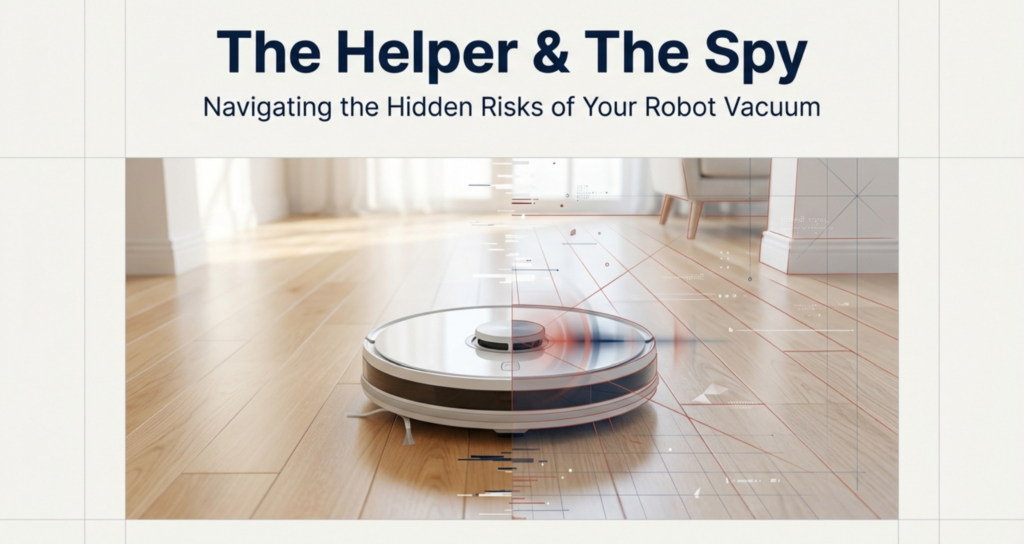
Studies show a lot of people set up smart home devices without really understanding the robot vacuum privacy risks and broader smart-home security issues they’re signing up for. Robot vacuums with mapping features draw up detailed floor plans, and higher-end models use cameras to spot furniture or even recognize objects. All that information usually gets sent off to company servers—sometimes it’s stored, sometimes analyzed, and sometimes even sold to advertisers. That part’s a bit unsettling, isn’t it?
The good news: you can still enjoy the convenience of a robot vacuum without ignoring robot vacuum privacy risks. Disabling features you don’t use, keeping your device updated, and choosing secure robot vacuum brands with a good security track record can help a lot. It’s worth checking what your vacuum is collecting and how to tweak those settings. That way, you stay in control and can pick a more privacy-friendly robot vacuum that matches your comfort zone.
Key Takeaways: Robot Vacuum Privacy Risks in Plain Language
- Robot vacuums with cameras, LIDAR, and mapping features collect detailed info about your home’s layout and your daily routines, which is at the heart of most robot vacuum privacy risks.
- Privacy risks include hackers accessing camera feeds, companies sharing your data with third parties, and security breaches exposing sensitive home maps, Wi-Fi details, and smart home vacuum privacy data.
- You can lower risks by choosing devices with solid encryption, turning off features you don’t need, favoring safe robot vacuums without cameras when possible, and going with brands that have a strong security and data-protection reputation.
Key Robot Vacuum Privacy Risks You Should Understand First
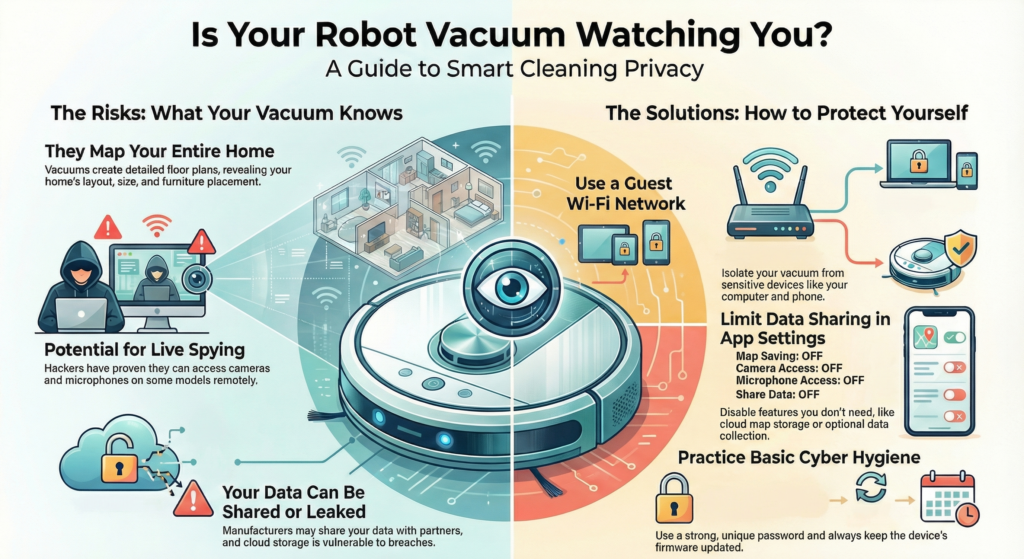
When looking at robot vacuum privacy risks, one of the biggest concerns is how much data these devices gather about your home through their sensors, cameras, and Wi-Fi connections. That creates some real risks around how this data is stored, transmitted, and who can get their hands on it—sometimes even people who definitely shouldn’t.
Potential for Location Tracking and Routine Profiling
Robot vacuums keep logs of when and where they clean. This data can reveal your routines—like when you’re usually home or out—and is one of the quieter robot vacuum privacy risks most people don’t think about. Some models send this info to the cloud, where it’s linked to your account.
Combine this with other smart home data, and suddenly there’s a detailed timeline of your household’s comings and goings. Companies may share this info with third parties or use it for advertising. The data collection habits of robot vacuums often go further than most people expect when they first set them up, increasing both privacy and data-security risks.
Mapping of Home Layouts and Smart Home Vacuum Privacy
Today’s robot vacuums build up detailed maps showing your room sizes, where your furniture is, and the general layout of your place. It helps them clean better, but it’s also pretty sensitive smart-home vacuum privacy information if you think about it.
Manufacturers usually store these maps on the cloud so you can access them from your phone. In 2022, when Amazon said it wanted to buy iRobot, people started wondering what would happen to all that mapping data. Cheaper brands aren’t always upfront about how they handle your maps either, which adds another layer to robot vacuum privacy risks.
Audio and Visual Data Collection (Cameras and Mics)
Some higher-end vacuums have cameras and even microphones so they can avoid cords or pet messes. These sensors might catch images of you or your family just going about your day. In 2022, test Roombas snapped some internal photos that ended up on social media after contractors leaked them—one of the clearest real-world examples of robot vacuum privacy risks.
And in 2024, researchers showed that hackers could access cameras and microphones on Ecovacs robots without any lights turning on. Even vacuums without mics aren’t off the hook—researchers figured out how to use LIDAR sensors to pick up sound vibrations and piece together speech. That’s a bit wild, honestly, and shows why choosing a safe robot vacuum without camera can dramatically reduce your exposure.
What Data Do Robot Vacuums Collect—and Why It Matters for Privacy
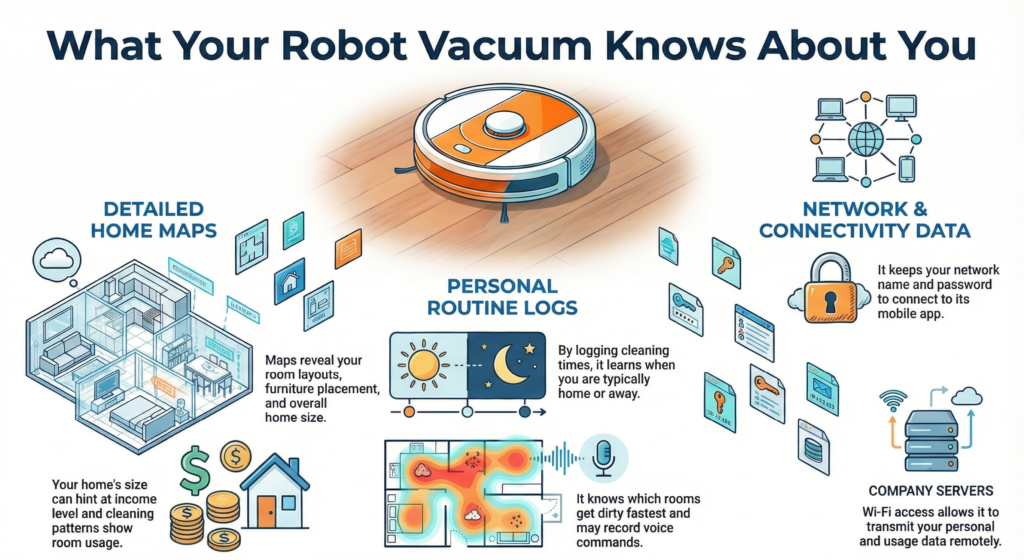
Robot vacuums scoop up a lot of info about your home and your daily life using sensors, cameras, and their network connections. This can include everything from detailed maps to logs of when you’re home or away, which is why robot vacuum privacy risks are more serious than many beginners assume.
Home Map Schematics and Room-by-Room Data
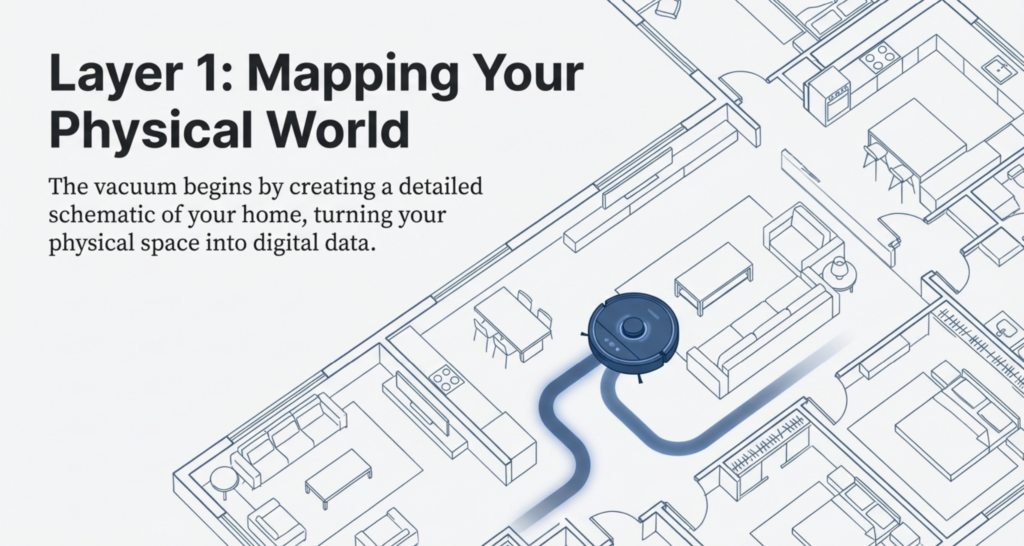
Newer robot vacuums map out your home so they can clean more efficiently. These floor plans show room layouts, where the furniture sits, and how big your place is overall—core data behind many robot vacuum privacy risks.
The fancier models use cameras, lasers, or GPS to build these maps. You’ll see room sizes, doorways, and exactly where obstacles are. Some vacuums even keep maps for multiple floors if you have them.
These maps can hint at your income level based on your home’s size and setup. They also show which rooms get cleaned the most. The device logs every cleaning run and tracks how it moves through your place—valuable data if it ever leaks in a breach or is shared too widely.
Usage Logs and Cleaning Patterns (Your Daily Routine)
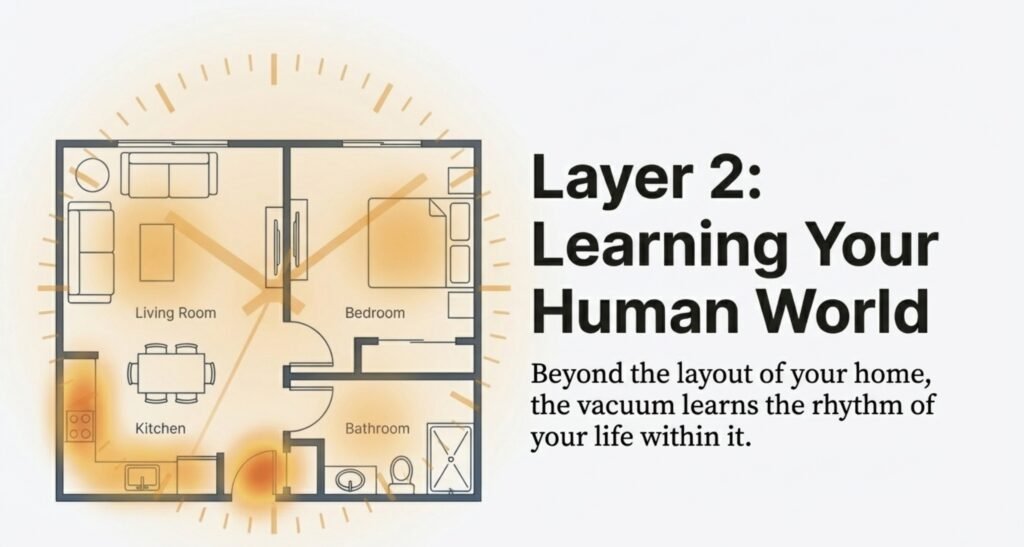
Robot vacuums keep track of when they clean, how long each session lasts, and what areas they cover. Over time, this builds up a detailed picture of your routines and habits, adding to overall robot vacuum privacy risks if the data is mishandled.
Your vacuum logs cleaning schedules, so it knows when you’re likely home or gone. It tracks which rooms get dirty fastest. Some models even record voice commands if you use Alexa or Google Assistant to start them.
This usage data reveals patterns—work hours, lifestyle clues, even home layout details manufacturers might use to design new products. With cameras, some brands can snap images as they clean, turning simple cleaning runs into a stream of personal data.
Wi-Fi Network Information and Robot Vacuum Data Security
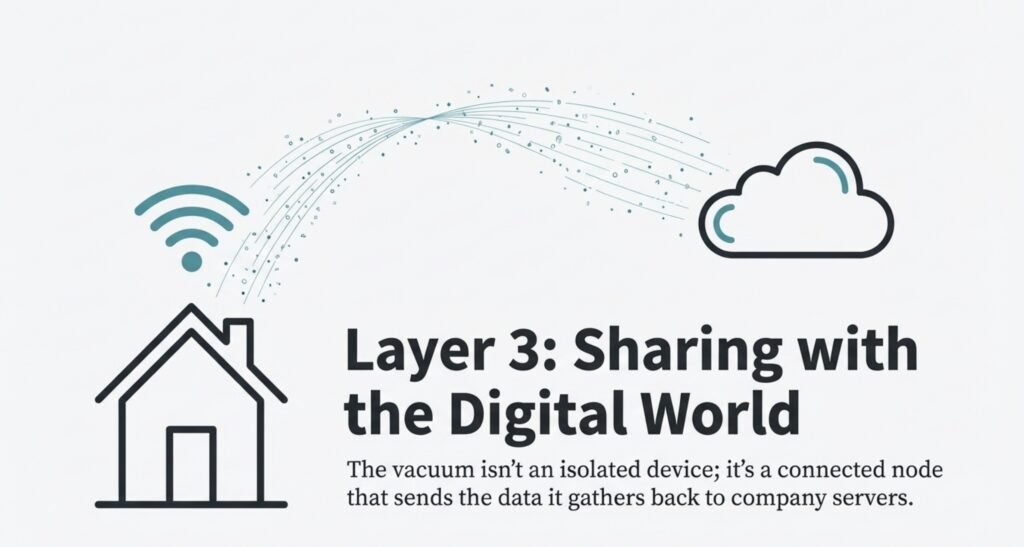
To let you control them from your phone, robot vacuums need access to your Wi-Fi. They store your network name, password, and connection info to stay in touch with their apps, which directly ties robot vacuum data security to how strong your home network settings are.
These devices link to user accounts, which usually means giving up your email and some personal details. The Wi-Fi connection lets the vacuum send data back to the company’s servers. Some models also talk to other smart home gadgets on your network.
Wi-Fi access makes it easy for your vacuum to send and receive info, but it also opens a door for data to leave your home. Sure, you get handy features like remote scheduling, but there’s always a trade-off between convenience and robot vacuum privacy risks. If you’re very cautious, you can even buy a robot vacuum without Wi-Fi for maximum isolation.
How Robot Vacuum Data Can Be Exposed or Misused
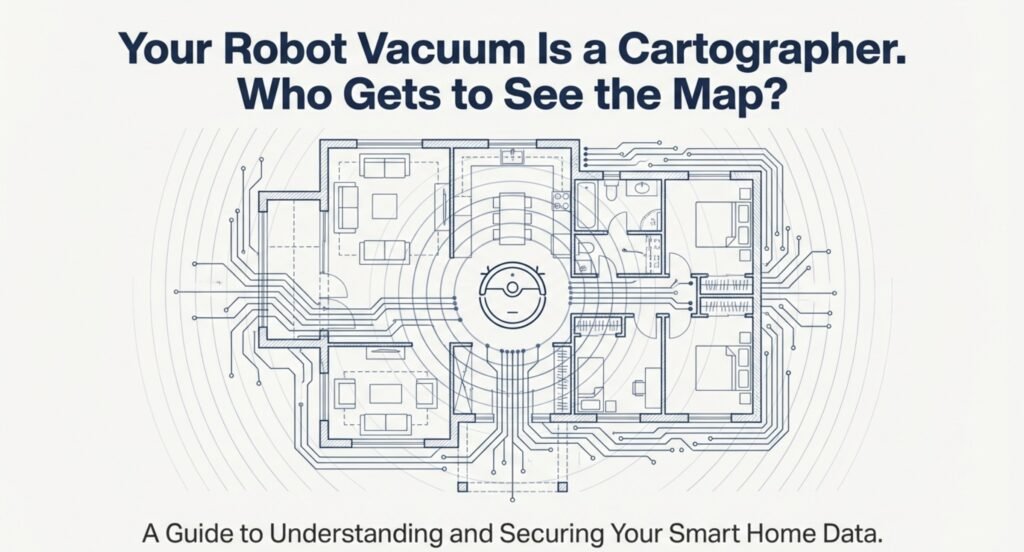
Robot vacuum data can slip out through company policies, cloud storage setups, or weak Wi-Fi at home. Each of these pathways adds to overall robot vacuum privacy risks if you’re connecting these devices to your network without extra precautions.
Manufacturer Data Sharing Practices and Third-Party Access
Robot vacuum companies collect all sorts of info about your home and cleaning habits. Plenty of brands share this with partners, or use it to show you ads. Eufy, for example, got caught uploading footage to the cloud even though they claimed everything stayed local—a major wake-up call about robot vacuum privacy risks.
Privacy policies are often vague—lots of talk about sharing info with affiliates or service providers. Some companies sell “anonymized” data. Others might hand it over to parent companies or advertisers.
It’s smart to check your vacuum app’s privacy settings and turn off anything you don’t need. Many devices let you disable cloud features or limit what gets shared. Reading the privacy policy before you buy is one of the simplest ways to reduce robot vacuum privacy risks up front.
Cloud Storage, Third-Party Access, and Robot Vacuum Cloud Storage Concerns
When your robot vacuum syncs with the cloud, your home maps and usage data leave your device. That opens the door to breaches or outside access. Test photos from Roomba units showed up on social media after contractors leaked images from a data-labeling platform—exactly the kind of robot vacuum cloud storage concerns privacy-minded users worry about.
Cloud storage means sensitive details about your home are sitting on someone else’s server—prime targets for hackers. Some companies pay third-party workers to review images for AI training, so strangers might see whatever your vacuum’s camera picks up.
Encryption helps keep cloud data safe, but nothing’s foolproof. Some brands offer local-only storage, which gives you more control. Often, you can turn off cloud syncing in the settings to keep maps just on your device or phone—one of the best ways to shrink robot vacuum privacy risks without losing all the smart features.
Risks from Weak Network Security and Hacking Attempts
Robot vacuums need your Wi-Fi, which can make them a target for hackers. Researchers found Ecovacs vacuums with vulnerabilities that let hackers control cameras without you knowing—turning them into roaming spy devices and highlighting serious robot vacuum hacking risks.
Leaving default passwords or skipping software updates makes things worse. In one 2018 case, a Chinese vacuum with the password “admin:888888” gave full remote access. Weak Wi-Fi security can let nearby attackers slip in during setup.
Always change default passwords and use two-factor authentication if it’s available. Keep your vacuum’s software up to date. If you can, put smart home devices on a separate guest network—if a hacker gets in, they won’t have access to everything else, which dramatically reduces overall robot vacuum privacy risks.
Robot Vacuum Privacy Risk Level: How Big Are the Risks Really?
Robot vacuums generally fall into the medium to high privacy-risk zone depending on the brand and which smart features you enable. Models with cameras, microphones, and always-on cloud connections carry higher robot vacuum privacy risks, while LIDAR-only or offline robot vacuum cleaner options tend to be safer.
Assessing Today’s Threat Landscape for Robot Vacuum Privacy Risks
The risk for robot vacuum users has increased as these devices get smarter. Security researchers in 2024 demonstrated they could take over Ecovacs Deebot vacuums and access cameras and microphones without triggering any indicator lights—essentially turning them into silent spying devices, and proving how serious robot vacuum privacy risks can be.
In 2022, test photos from Roomba vacuums leaked online, including images from bathrooms. These were test units, but the leak showed how easily private visuals can escape corporate control. Researchers also managed to use LIDAR sensors as makeshift microphones—a technique called “LidarPhone”—highlighting unexpected robot vacuum data security vulnerabilities.
Data breaches remain a major element of robot vacuum privacy risks. Eufy once claimed its cameras never sent footage to the cloud—yet independent testers found unencrypted video streaming online. Too often, privacy promises do not match the real-world security behavior of the device.
What Increases or Decreases Robot Vacuum Privacy Risks
Higher-risk features include built-in cameras, microphones, AI image capture, and constant cloud syncing. Devices that store maps and images on remote servers also raise robot vacuum privacy risks, and cheaper brands with vague policies or weak encryption tend to be the most vulnerable.
Lower-risk options use only LIDAR or basic sensors (no cameras), or operate as offline robot vacuum cleaner models. Devices that store maps locally instead of the cloud are far safer. Brands with certifications like TÜV SÜD or ETSI EN 303 645 typically offer stronger protections.
Using strong passwords, turning on two-factor authentication, and keeping firmware updated all reduce robot vacuum privacy risks. If you don’t need the camera, turn it off—or better yet, buy a safe robot vacuum without camera. Placing devices on a guest Wi-Fi network is another easy layer of protection.
How Beginners Can Improve Robot Vacuum Privacy and Security
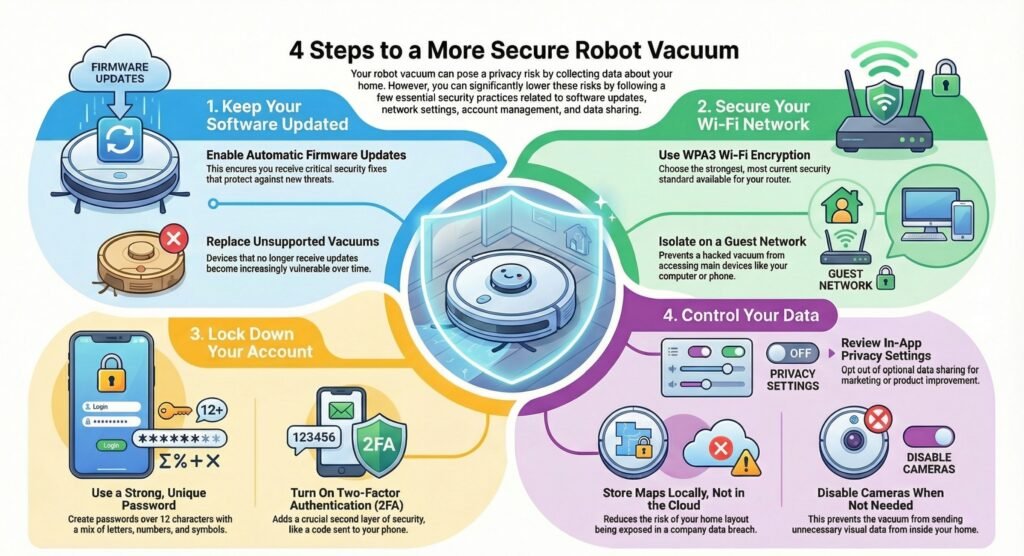
Keeping your robot vacuum safe from robot vacuum privacy risks isn’t as complicated as it sounds. It mostly comes down to updating its software, securing your home Wi-Fi, using strong passwords, and tweaking privacy settings so you’re not sharing more data than necessary. These simple steps dramatically lower the chances of someone accessing or misusing your information.
Update Firmware and Security Patches Regularly
Robot vacuums need firmware updates frequently. These updates fix vulnerabilities hackers may try to exploit. For example, Ecovacs Deebot flaws discovered in 2024 allowed unauthorized access to cameras and microphones—one of the strongest demonstrations of robot vacuum privacy risks.
Most vacuums update themselves via their apps. Turning on automatic updates ensures you receive security fixes immediately. If automatic updates aren’t available, check manually once a month.
Older devices eventually stop receiving updates. Once support ends, the robot vacuum privacy risks increase significantly. If your vacuum no longer receives firmware patches but still connects to Wi-Fi, consider replacing it—preferably with a privacy-friendly robot vacuum.
Enable Strong Wi-Fi Encryption and Use Guest Networks
Your Wi-Fi security has a major impact on robot vacuum data security. Ideally, your router should use WPA3 encryption. WPA2 works, but it’s less secure.
It’s smart to place your robot vacuum on a guest network. This isolates it from your main devices, so even if compromised, the attacker won’t reach your phone or computer. Most routers support guest networks by default.
If your router doesn’t support WPA3 or proper network isolation, upgrading to something like the ASUS RT-AXE7800 tri-band Wi-Fi 6E router adds WPA3, malware blocking, and better IoT separation. Stronger Wi-Fi security directly reduces robot vacuum privacy risks.
Why this is a good pick
- Explicitly advertises WPA3 security and AiProtection Pro (Trend Micro-powered security layer with automatic updates).
- Directly supports your recommendation to use strong Wi-Fi encryption and guest networks to isolate smart devices.
- Gives you a non-vacuum monetization angle in a section that’s already naturally talking about routers and security.
Make sure the guest network uses a different password than your main Wi-Fi. That way, if someone gets the vacuum’s Wi-Fi info, they still can’t get into your other stuff.
For an extra layer of protection, especially if you own multiple smart home gadgets, a device like the Firewalla Purple SE home network firewallcan sit on your network and watch for suspicious traffic from IoT devices like robot vacuums, while also letting you easily block or throttle them from a mobile app.
Why this is a good pick for this article
- Designed specifically for home and small business networks, with intrusion detection, content filtering, and analytics.
- Fits perfectly with the idea that robot vacuums can be an entry point to your network and that users should harden their home network, not just the device.
- Gives a premium, upsell-style solution that fits naturally into your “lock down your Wi-Fi”.
Set Unique, Strong Passwords and Use Authentication Methods
Don’t reuse passwords for your robot vacuum account. Reused passwords increase overall robot vacuum privacy risks if any linked service is compromised. Use at least 12 characters with mixed symbols.
Password managers generate strong unique passwords for every platform, reducing security exposure.
Two-factor authentication adds an extra lock on your account. Even if someone guesses your password, they still can’t access the app—reducing potential robot vacuum privacy risks.
Limit Data Sharing Through Privacy Settings
Most robot vacuum apps include privacy settings that let you limit what gets collected and shared. Reviewing these settings right after setup helps reduce long-term robot vacuum privacy risks. Some secure robot vacuum brands, like iRobot, provide clearer privacy controls than others.
Many vacuums let you disable cloud storage entirely. Keeping maps stored locally instead of sending them to servers significantly reduces robot vacuum cloud storage concerns. Some models can even run fully offline, which is the best-case scenario for privacy.
It’s usually best to disable optional data sharing for marketing or analytics. These settings don’t improve performance but do increase robot vacuum privacy risks. Always review the company’s privacy policy to see how your data may be used.
If your vacuum has cameras, turn them off when possible. Some models allow deactivating obstacle cameras while leaving navigation sensors active. This reduces the risk of leaked visuals and supports a safe robot vacuum without camera approach.
Choosing Safer Robot Vacuums and Brands With Lower Privacy Risks
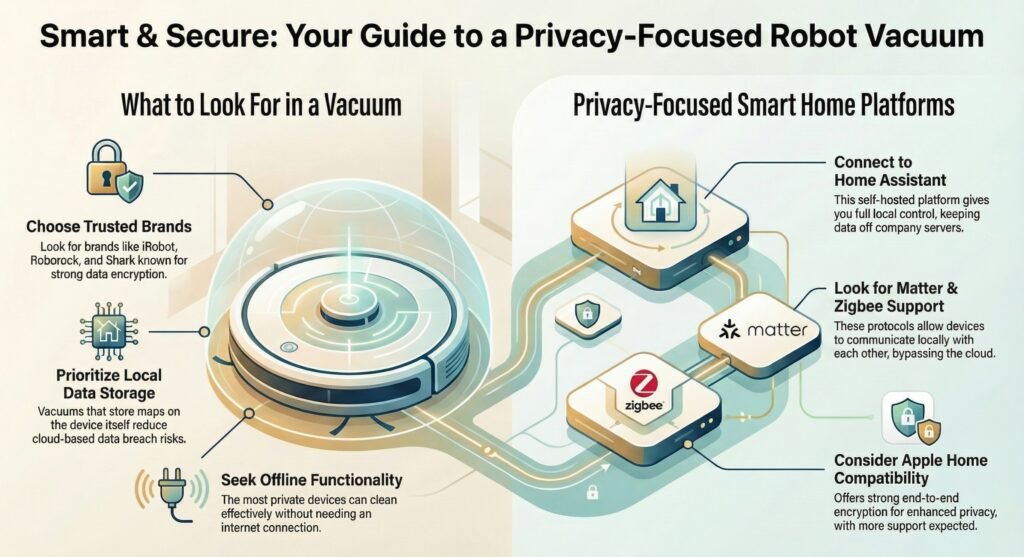
Some brands simply offer better protection. They use stronger encryption, keep data stored locally, and maintain clearer privacy rules. Choosing a privacy-friendly robot vacuum—or one that avoids cloud dependence—can dramatically reduce robot vacuum privacy risks.
Brands With Good Privacy Track Records
iRobot has strengthened privacy measures recently. They encrypt user data, allow detailed privacy controls, and let you delete maps or disable cloud storage—ideal for reducing robot vacuum privacy risks.
If you want a camera-free option from a big brand, the iRobot Roomba i3 EVO robot vacuummaps your floors using floor-tracking sensors instead of a front camera while still giving you app control and scheduled cleaning.
Why this is a good pick
- Uses floor-tracking sensors rather than a navigation camera, which is less invasive than models with always-on video. iRobot+1
- Directly matches your advice to choose brands with better privacy controls (map deletion, settings, etc.).
- It’s a realistic “middle-ground” recommendation for readers who do want app features but feel uneasy about onboard cameras.
Roborock is also solid—they encrypt data and let you use the vacuum without the cloud. Their vacuums work well with local controls, and so far, they haven’t had any big privacy scandals.
For a LiDAR-only model (no front-facing camera), the Roborock Q5+ robot vacuum with self-empty dockuses laser navigation instead of video to map your rooms, which feels more privacy-friendly while still giving you multi-level mapping and no-go zones.
Why this is a good pick
- Uses LiDAR navigation (lasers) rather than an RGB camera, which keeps your “fewer cameras in the house” story consistent. Roborock US Official Store+1
- Self-empty dock and multi-level mapping make it attractive for buyers and give you a strong commercial pick in a privacy-focused context. Roborock US Official Store+1
- Perfectly illustrates your point that “lower-risk options use only LIDAR or basic sensors (no cameras)”.
Eufy had some security issues back in 2022, but they’ve since improved their encryption and privacy options. Their newer vacuums protect your data better, and some Eufy models support local storage so you don’t have to upload anything to the cloud.
Shark’s added encryption to their robot vacuums, too. They focus on secure updates and let you pick what data you share.
Devices Supporting Local Storage Options
Vacuums that store maps locally instead of uploading them greatly reduce robot vacuum cloud storage concerns and overall privacy risks.
Models that save maps directly to the device or your phone are ideal. They continue working offline, and some even support Bluetooth transfer instead of Wi-Fi—useful for minimizing robot vacuum privacy risks.
Offline robot vacuum cleaner models are the safest choice. They never upload data, cannot leak maps, and eliminate cloud-related privacy risks entirely. Always check whether a model requires cloud connection before buying.
If you want to avoid Wi-Fi completely, the Eufy 11S Max robot vacuum (no Wi-Fi, remote controlled)runs fully offline with no app or cloud connection—great for beginners who want robot cleaning without putting anything on the network.
Why this is a good pick
- Confirmed no Wi-Fi / no app support – controlled only via the physical button and remote, so there is no cloud data at all. Amazon
- Aligns perfectly with your advice: “Devices that run offline are best for privacy.”
- Gives privacy-paranoid readers a “max safety” option you can contrast with smarter, cloud-connected vacuums.
Compatible with Privacy-Focused Platforms
Vacuums compatible with Home Assistant or Matter tend to offer more local control and fewer data-sharing requirements. This reduces robot vacuum privacy risks and gives you more control over what stays inside your home.
Matter and Zigbee are protocols that let smart devices talk to each other locally, not through the cloud. Some new vacuums are starting to add Matter support, which is promising.
Apple Home is pretty strong on privacy, thanks to end-to-end encryption. But, not many vacuums work directly with Apple Home yet. That could change as Matter gets more popular.
If your vacuum supports several platforms, you get more choices for privacy. You’re not stuck in one system, which is always nice.
What Real Users Say About Robot Vacuum Privacy Risks
Pain Points & Fears
- Privacy — “Are they secretly mapping/spying on my home?”
- Many users worry about detailed home-map collection, camera footage, and metadata that reveal routines—all core robot vacuum privacy risks discussed in forums and review sites.
- As one Redditor put it: root your vacuum or isolate it on a guest network to avoid floor-plan and WiFi info being sent somewhere unknown. Reddit+1
- There is worry that even without cameras, metadata (network traffic patterns) could reveal private details like how often you’re home, or when you clean. arXiv+1
- Hacking & Unauthorized Access — “What if someone hacks in?”
- Multiple confirmed cases of hacking, data leaks, and remote access attempts reinforce user fears and validate concerns about robot vacuum hacking risk.. Kaspersky+1
- That means a vacuum could be turned from a “helpful cleaner” into a “mobile surveillance device” — for strangers. One real story involved a family whose device was exploited to take photos and spy on them. ABC+1
- Opaque / Vague Manufacturer Policies — “I don’t know what data they collect or share.”
- According to journalist and consumer-rights reporting, most robot vacuum makers score poorly on clarity around data privacy. Users often can’t find clear answers about what’s collected, how long it’s stored, or whether data is shared with third parties. Consumer Reports+1
- That creates uncertainty, which many respondents find unsettling — especially for devices that roam freely around private spaces (bedrooms, living rooms, kids’ rooms, etc.).
- Compounded Smart-Home Risk — “One device is just the start.”
- Some users worry especially when a vacuum is part of a larger smart-home ecosystem. If one smart device is compromised, it could be used as a foothold to attack other devices or leak more sensitive data (phones, cameras, build-in assistants). Kaspersky+2arXiv+2
- This makes the vacuum not just an isolated concern but a potential gateway vulnerability for the whole home network.
⚖️ Conflicting Opinions & Trade-offs
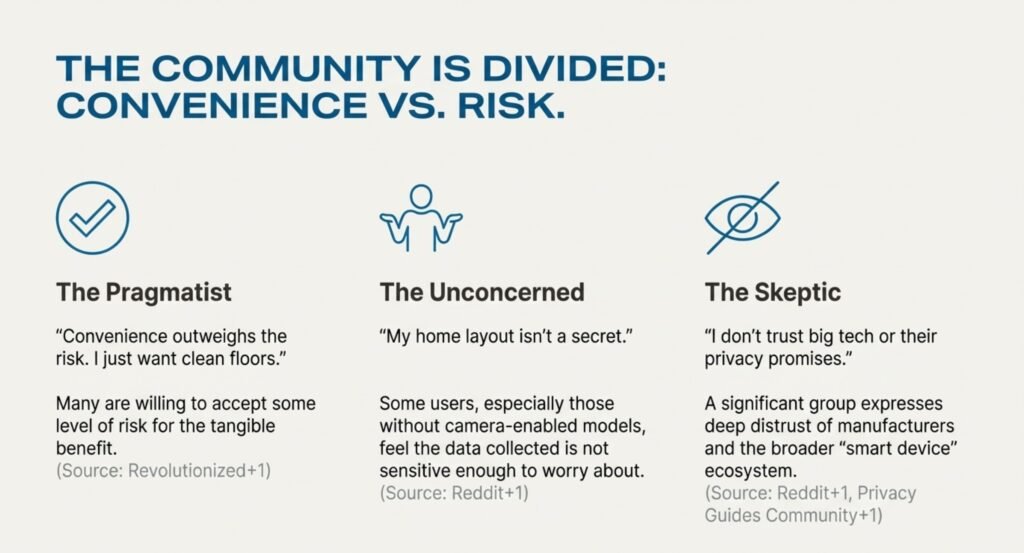
- “But I don’t care — my home layout isn’t a secret.”
- Some users are comfortable with the mapping aspect, reasoning that their general floor plan isn’t private (especially in apartments or public housing) — so privacy trade-off feels minimal in return for convenience. Reddit+1
- For them, as long as the vacuum doesn’t have a camera (only LIDAR or IR), the risk seems acceptable. Reddit
- “Convenience outweighs risk — I just want clean floors.”
- Particularly among busy users or families, many emphasize the convenience factor — and are willing to accept some level of risk for the benefit of automated cleaning. Revolutionized+1
- In some threads, people suggest a “risk-aware” approach: yes, there are risks, but with precautions (guest network, separate VLAN, strong password), it’s manageable. Reddit+1
- Many remain skeptical that certifications guarantee safety. Real-world breaches often matter more than labels when evaluating secure robot vacuum brands.
- Even vacuums from major brands claiming encryption or compliance with IoT security standards don’t fully reassure certain users — especially after real hacks have broken in. Kaspersky+2Vacuum Wars+2
- For some, publicized “certificates” feel more like marketing than a guarantee of safety. Kaspersky+1
😟 Emotional Triggers & Common Feelings
- Fear and discomfort — “This is creepy / invasive.”
- Many express unease at the idea of a device roaming their home, capturing data, images or even audio. One person said: “It’s like having a webcam that can roll around your house and look at your family.” ABC+1
- The idea that a vacuum — something that should be mundane and helpful — could be used for spying triggers strong emotional reaction.
- Distrust and suspicion — “I don’t trust big tech / Chinese companies / IoT privacy promises.”
- Some users explicitly mention distrust of manufacturers, especially those with data-mining business models, or those headquartered in countries perceived as having weaker privacy protections. Reddit+1
- Others distrust “smart home convenience” more broadly — believing that smart devices trade privacy for convenience, which for them isn’t worth it. Privacy Guides Community+1
- Frustration and helplessness — “What can I even trust these days?”
- People often feel that even if they want to be safe, it’s unclear what “safe” really means: Which models? Which settings? Which network configurations? Consumer Reports+2arXiv+2
- Some admit that the technical countermeasures (separate VLANs, custom firmware) are beyond what an “average user” is comfortable or capable of doing. Reddit+1
✅ Potential Solutions, Workarounds & Advice People Give or Seek
Based on expert guidance, security research, and real-user advice — there are some recurring suggestions for making robot vacuums “less risky.”
- Isolate the Vacuum on a Separate Network (Guest Network / VLAN / IoT subnet)
- Many experienced users recommend putting the vacuum (and other smart devices) on a dedicated network separate from laptops, phones, or sensitive devices. That way, even if it’s compromised, damage is limited. Reddit+2The Guardian+2
- This is often described as a “basic hygiene” step — one of the best practical defenses for non-expert users. The Guardian+1
- Pick Models Without Cameras (Use LIDAR or IR Only)
- Some users avoid camera-enabled vacuums altogether; they see LIDAR or IR-mapping as “good enough” for cleaning, and far less privacy-risky. Reddit+1
- According to some vendors (and some users), opting for “local-only” processing (vs cloud storage) is a safer bet. Privacy Guides Community+1
- Use Strong Passwords, Enable Two-Factor Auth Where Possible, Keep Device Software Updated
- Basic cybersecurity best practices apply: use strong unique passwords for the vacuum’s app, enable MFA if available, and ensure firmware is up to date. ECOVACS US+2Kaspersky+2
- Some manufacturers (like DEEBOT / Ecovacs) let you request deletion of collected data, or disable video/image uploads — which users point to as positive signs. ECOVACS US+1
- Ask Questions / Read Privacy Policies Before Buying (Don’t Assume All Are Equal)
- Since different brands and models vary widely — in sensors, data handling, encryption, cloud-vs-local processing — users often recommend doing homework before buying. Consumer Reports+2Vacuum Wars+2
- Some even point towards niche “privacy-focused” vacuums (or even open-source firmware) as a better alternative — though acknowledging these may require technical skills. Privacy Guides Community+1
🎯 Insights & Patterns That Carry Emotional or Strategic Weight
- “Convenience vs privacy trade-off” is the central dilemma.
For many users, robot vacuums are deeply appealing for the time and effort saved — but that benefit is shadowed by uncertainty about what’s being collected, stored, and who might have access. This trade-off drives much of the hesitation or distrust. - When people learn about real hacks — sentiment shifts quickly from “meh” to “no way.”
Pre-hack, some are relatively relaxed. But real stories (remote camera access, device takeover, live spying) tend to alarm many users and shift them toward distrust or avoidance. The emotional reaction is strong: fear, anger, feeling “violated,” or exposed. - Many users treat smart-vacuum security like “Internet hygiene,” not “home safety.”
In other words: the risk often gets framed as “data risk / hacker risk” rather than “physical safety.” People thinking about it more as cybersecurity than physical intrusion — but they also show awareness that digital leaks can have real emotional/psychological consequences (privacy invasion, surveillance, data misuse). - There’s a gap between technical/academic awareness and average consumer understanding.
Security researchers highlight serious vulnerabilities, metadata leaks, passive traffic analysis — but many regular users don’t fully grasp those technical angles. As a result, some rely solely on manufacturer claims or certifications — which may be insufficient. - A minority of users embrace “DIY privacy”: custom firmware or local-only operation.
Some feel so strongly about privacy that they accept the trade-offs (potentially losing convenience) and use open-source or “local processing only” setups. These users exist — showing there is a niche, privacy-savvy segment in the audience.
Conclusion: Understanding Robot Vacuum Privacy Risks in 2025
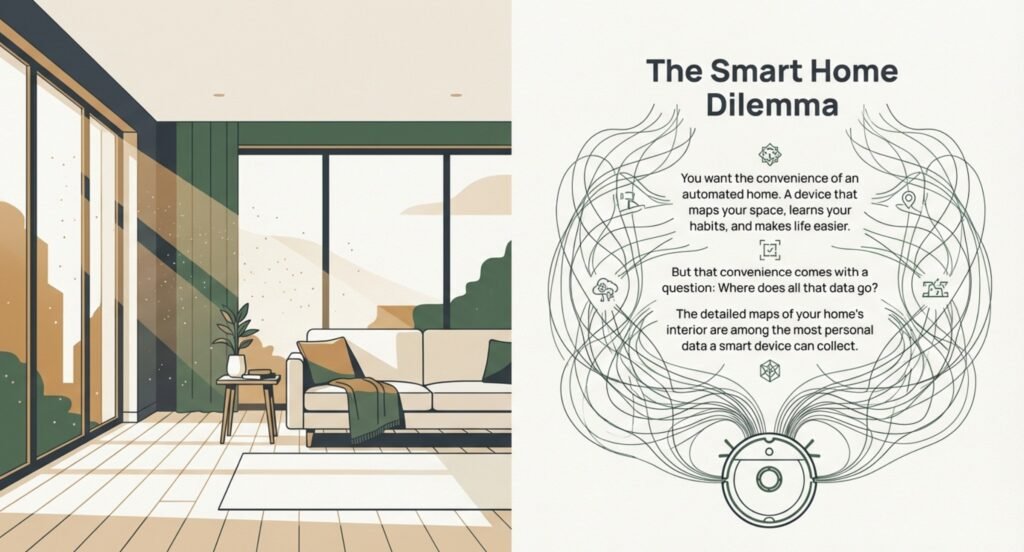
As robot vacuums become smarter and more connected, it’s important for beginners to understand the real robot vacuum privacy risks behind the convenience. These devices can collect detailed data—floor maps, routines, Wi-Fi details, and even images—depending on the model you use. But the good news is that most risks can be controlled with the right setup and the right vacuum.
If you’re concerned about data exposure, look for safe robot vacuum without camera designs, LIDAR-only models, or offline cleaners that don’t send anything to the cloud. Securing your home network, disabling unnecessary features, and choosing trusted brands with strong security practices can drastically reduce your risk.
Robot vacuums aren’t “dangerous,” but they do require awareness. By taking a few smart precautions and choosing privacy-friendly devices, you can enjoy the benefits of automated cleaning without compromising your home’s safety or your personal data.
Frequently Asked Questions About Robot Vacuum Privacy Risks
Robot vacuums collect all sorts of data while cleaning, and it’s normal to wonder how companies handle that info—or what you can do to protect yourself.
What types of personal information do robot vacuums collect while operating?
Robot vacuums collect floor maps, room layouts, cleaning patterns, Wi-Fi details, and sometimes camera images or audio. All of this contributes to robot vacuum privacy risks, especially if stored in the cloud.
Fancier models with cameras might snap pictures or even record video as they clean. Some have microphones for voice commands. They’ll also log things like your cleaning schedule, how often they clean, and which rooms get the most attention.
If you use a smartphone app, it might collect extra info—like your Wi-Fi details, email, or phone number. Some apps even use your phone’s location to start cleaning when you leave the house. It’s a lot, honestly.
How can consumers ensure their robot vacuum’s data is secure?
To improve robot vacuum data security, use strong unique passwords, isolate devices on a guest network, keep firmware updated, and disable unnecessary cloud features or cameras.
Set up a separate network for smart devices. Many routers let you create a guest or IoT network to keep gadgets like vacuums away from your main computers and phones. That way, if the vacuum gets hacked, the rest of your stuff is safer.
Keep your vacuum’s software up to date. Turn on automatic updates if you can, or check for updates every month. Go through the app’s privacy settings and turn off features you don’t need, like cameras or cloud storage.
What are the common risks associated with smart home devices like robot vacuums?
The biggest risks include unauthorized camera access, leaked home maps, cloud breaches, and vendors sharing data with advertisers. These are the most commonly reported robot vacuum privacy risks.
Another risk is data breaches at the company itself. If your maps and usage data are stored in the cloud, a breach could leak info about your home or routines. That could even tip off burglars about when you’re away.
Some vacuums just have weak security, making them easy targets. A compromised smart device can be a doorway for hackers to attack other things on your network, like your computer or phone.
There’s also the issue of companies selling or sharing your data. Some might hand off your info to advertisers or research firms. Even floor plans could be valuable to insurance or real estate companies. It’s a little unsettling, to be honest.
Can the use of robot vacuums increase the likelihood of cyber attacks on home networks?
Yes. Robot vacuums add new entry points to your network. If unpatched or poorly secured, they can expose you to robot vacuum hacking risk, especially on weak Wi-Fi or reused passwords.
A lot of vacuums run on outdated software and don’t get updates anymore, so they’re easier for hackers to target. Attackers often use automated tools to scan for these weak spots across tons of devices.
How you set up your network matters a lot. If your vacuum is on the same network as your main devices, it’s riskier. Separating your networks helps a lot—if one device gets hacked, it’s harder for the hacker to reach everything else.
How do manufacturers protect the privacy and security of robot vacuum users?
Good manufacturers use encryption, regular firmware updates, and local processing to lower robot vacuum privacy risks. However, protections vary widely between brands.
Most companies use secure logins and sometimes two-factor authentication for their apps. Some are starting to process data locally instead of in the cloud, so your maps stay on the vacuum itself.
Big brands do security audits and push out firmware updates to patch problems. They’ll often work with independent security researchers, too. But honestly, the quality of protection varies a lot between brands.
Privacy policies should explain what data is collected and how it’s used. The better companies give you control in the app—letting you opt out of cloud storage or delete your info from their servers if you want.
What steps can individuals take to minimize the privacy risks of smart home technologies?
To minimize robot vacuum privacy risks, choose privacy-focused models, disable unnecessary cloud features, place devices on guest networks, check app permissions, and prefer safe robot vacuum without camera or LIDAR-only models when possible.
Once everything’s set up, turn off features you don’t really use. For example, if you never use voice commands, why leave the microphone on? Turning it off cuts down on risk. Same goes for cloud storage—if you can, keep your data stored locally so it doesn’t leave your home network.
It helps to put your smart home gadgets on their own network, away from your personal stuff. You can usually do this in your router settings, or maybe use a mesh network built for smart devices. Setting up some basic firewall rules is another good move for extra safety.
Don’t forget to check for updates every month if your devices don’t do it automatically. It’s also worth glancing at app permissions now and then—make sure your robot vacuum isn’t poking around where it shouldn’t. And if you ever swap out or get rid of a device, doing a factory reset will clear your personal data off it.