
As an Amazon Associate, we may earn a commission if you make a purchase — at no extra cost to you.
Best Video Doorbell Without Subscription (No Monthly Fees, Local Storage Options)
If you’ve ever bought a video doorbell and then realized the useful stuff is locked behind a monthly plan, you already know the frustration. You paid for the hardware—but you’re still renting your own recordings. Cancel the subscription, and suddenly features disappear, playback gets limited, or your video history vanishes altogether.
The good news is that you can absolutely get a video doorbell without a subscription that still covers the essentials: fast motion alerts, clear live view, two-way talk, and recorded clips you can actually keep. The real difference isn’t the camera lens—it’s where your footage lives. With local storage, clips stay on the device, a microSD card, a home hub, or your own network instead of being locked behind a paid cloud plan.
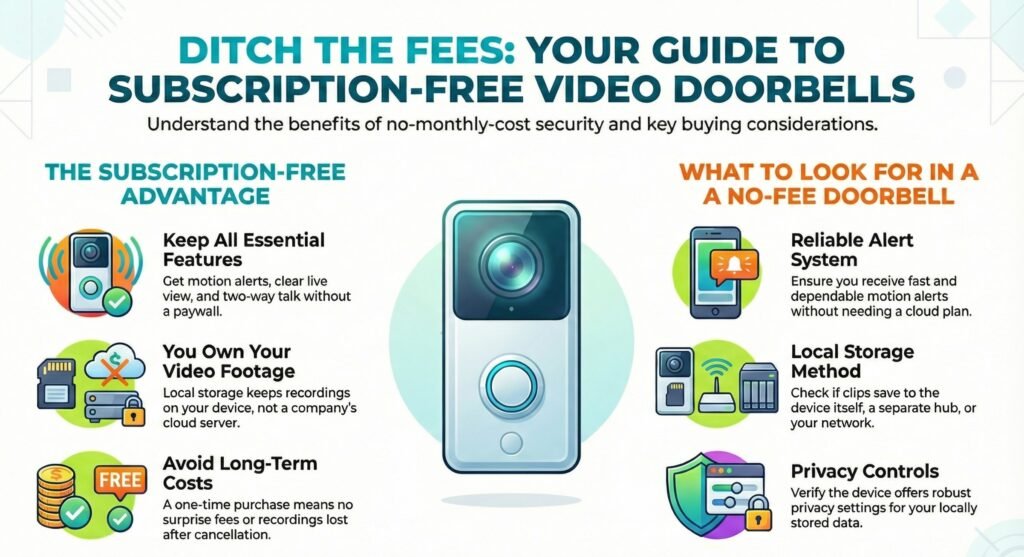
This guide is here to save you from buyer’s remorse. In the next few minutes, you’ll see what really matters when you skip monthly fees—how local storage works in real life, which alerts stay reliable without paying, what tradeoffs to expect, and whether wired or battery makes more sense for your entry—so you can buy once and stop paying forever.
Key Takeaways
- A video doorbell with no monthly fees can still cover the essentials—alerts, live view, and recorded clips—without paywalls.
- Your best bet depends on storage, alerts, and what it’ll work with.
- Making a clear decision is better than getting lost in specs.
What You Give Up and Keep With a Smart Doorbell Without Subscription Plan
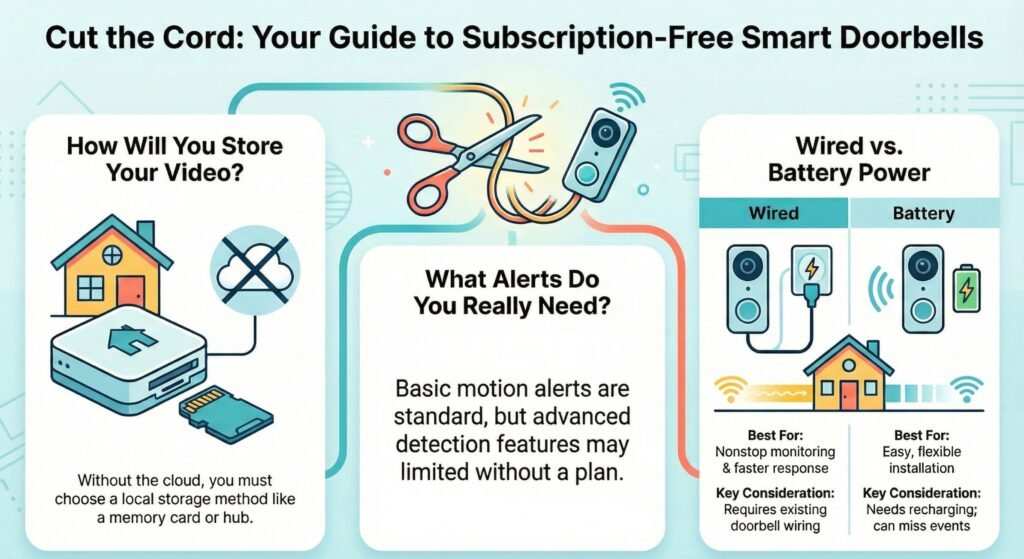
This guide helps you figure out if a video doorbell without a subscription fits your home and your daily routine. You’ll see what you gain—and what you might miss out on—when you skip monthly payments.
You’ll decide how you want the doorbell to store video. Some models use a memory card or a hub, while others save everything on your network. Each one changes how you set things up, how you get your videos, and how much control you keep.
You’ll learn how alerts and detection work without a cloud plan. Motion alerts are still there, but some fancy features might be missing. This guide helps you figure out which alerts actually matter for you.
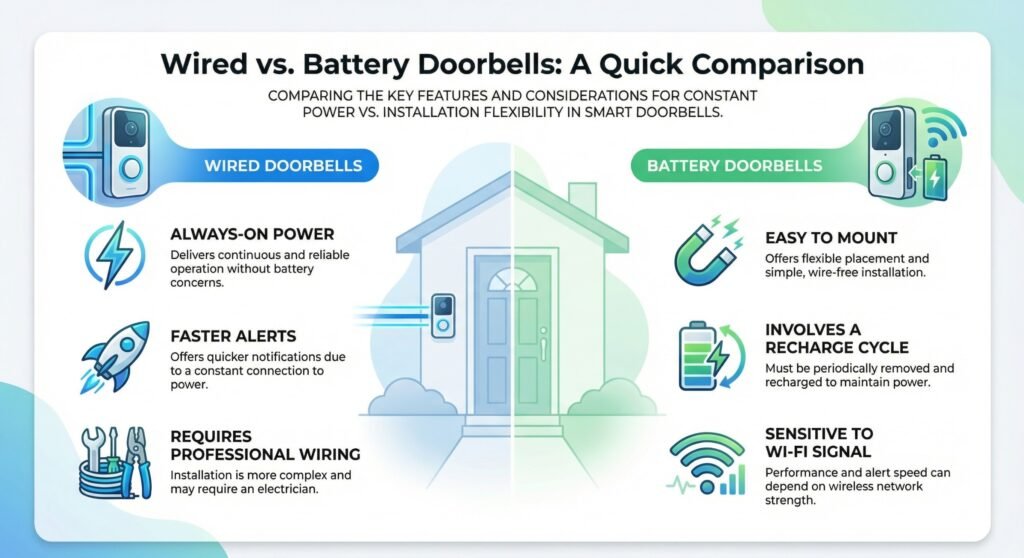
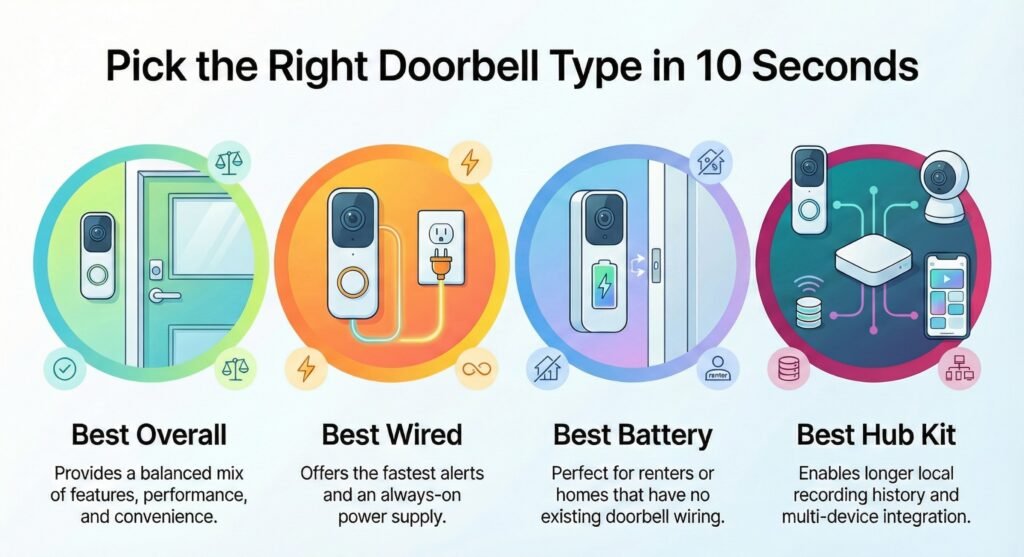
You’ll pick the power setup that works for your door. For wired vs battery video doorbell no subscription, wired is usually better for nonstop monitoring and faster response, while battery is easier to mount but needs recharging and can miss events if power-saving is aggressive.
Table 1: Wired vs Battery Mini Comparison Table
| Wired | Battery | |
|---|---|---|
| Best for |
consistent monitoring Homes with existing doorbell wiring and frequent motion events. |
easy install Renters or homes without wiring who want fast setup. |
| Main upside |
always on Faster alerts, no battery limits, fewer missed events. |
flexible placement Mount almost anywhere without electrical work. |
| Main downside |
needs wiring Installation may require existing wires or an electrician. |
battery management Needs recharging and may reduce sensitivity to save power. |
| What to prioritize | Stable Wi-Fi, fast alerts, continuous reliability. | Battery life, signal strength, and motion settings. |
You’ll get a sense of how privacy and data control change. Local storage means your video stays at home. No cloud means less outside access, but maybe not as much remote sharing.
You’ll also decide if smart home support is a must. Some doorbells work with voice assistants or smart displays. Others just stick to basic doorbell stuff.
Here are a few questions to ask yourself before you start shopping:
- Do you want zero monthly cost, even if that means keeping it simple?
- Would you rather have local control than cloud convenience?
- Do you need a super fast install, or are you okay with wiring?
- Do you want just alerts, or do you need video evidence too?
Answering these narrows down your choices fast—and saves you from buyer’s remorse.
Quick Checklist: pick a video doorbell no monthly fees in 60 seconds
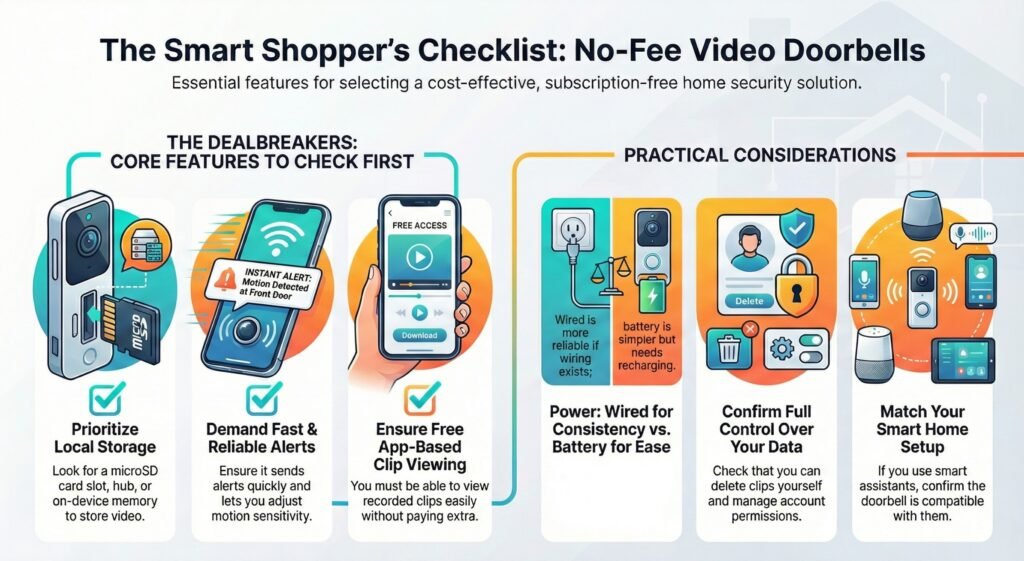
Use this checklist to pick a video doorbell no monthly fees without getting lost in specs. If you can answer these in a minute, you’ll avoid most buyer regret.
Storage (the dealbreaker)
- ✅ Does it have local storage (microSD, hub, or on-device memory)?
- ✅ Can you view clips easily in the app without paying?
- ✅ Does it overwrite old clips automatically?
Alerts (what actually matters)
- ✅ Does it send fast motion alerts reliably?
- ✅ Can you adjust sensitivity to reduce false alerts?
Power (wired vs battery)
- ✅ If wiring exists, wired is usually more consistent
- ✅ If not, battery is easier—but plan for recharging
Privacy and control
- ✅ Can you delete clips whenever you want?
- ✅ Can you turn off sharing or reduce account permissions?
Smart home fit
- ✅ If you want integrations, confirm it works with your setup
- ✅ If you don’t, skip the “ecosystem” complexity
If your answers are mostly “yes,” you’re already close to the best video doorbell without subscription for your needs. If you keep hitting “not sure,” focus on storage and alert quality first—everything else is secondary.
Table 2: Decision Maker Table (choose-your-fit)
| If you want… (scenario) | Choose this storage type | Choose wired or battery | Prioritize this feature | Avoid this common mistake |
|---|---|---|---|---|
| I only want to stop monthly fees |
microSD
on-device Simple local clips with no paywall surprises. |
wired if you have wiring battery if you don’t |
Local playback in the app (no subscription prompts) | Buying a “no subscription” doorbell that still blocks clip playback behind a plan |
| I need to save clips for longer |
hub or microSD Bigger storage + clearer overwrite behavior. |
wired (best for frequent events) battery (ok if motion volume is moderate) |
Storage size + overwrite settings + easy export/download | Choosing tiny built-in storage and assuming it keeps “weeks” of history |
| I want the easiest install |
microSD or on-device Fewer parts = fewer setup steps. |
battery (fastest install) | Strong Wi-Fi connection + simple mounting + quick app setup | Placing it too far from your router and blaming the doorbell for lag/drops |
| I travel a lot and need remote checks |
hub or microSD Local storage + reliable app access. |
wired (best uptime) battery (fine if you can recharge) |
Reliable live view + fast alerts + stable app performance | Assuming “no subscription” means “no remote viewing” (often false) or buying without checking app stability |
| I care most about privacy |
microSD
hub
on-device Local storage keeps footage off third-party servers. |
wired (steady, fewer power limits) battery (ok if you prefer flexibility) |
Local-only clip control + clear sharing controls + strong app security | Leaving default account permissions on, or ignoring clip deletion/export controls |
Tip: This table is intentionally product-free to reduce analysis paralysis. Add product picks later once the reader “picks a lane.”
Key Buying Factors for the Best Video Doorbell Without Subscription
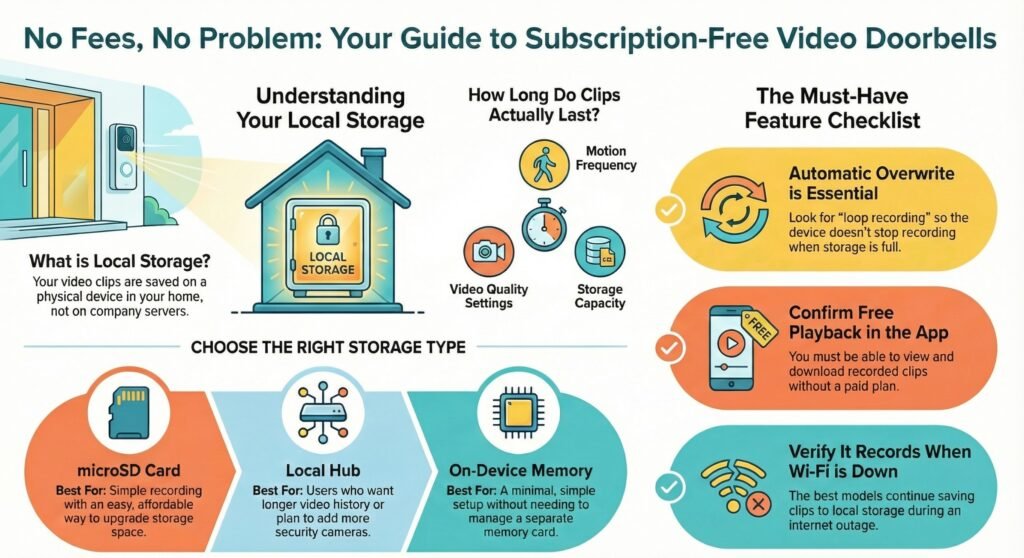
When you skip monthly fees, the hardware you choose matters even more. Storage, alerts, and how you control your data decide whether the doorbell feels useful day-to-day—and how well it fits your smart security setup.
Video Doorbell With Local Storage: microSD, hub, or on-device memory
A video doorbell with local storage is ideal when you want recordings you can actually keep and review without paying monthly. Most subscription-free models save clips to microSD cards, built-in memory, or a local hub. Each has its own pros and cons for cost, space, and reliability.
What to check before you buy:
- Storage location: On-device storage keeps your video safe even if your internet goes out.
- Capacity limits: Some models only offer 8 GB, which fills up pretty quickly.
- Expandability: MicroSD slots let you add more space later on, usually for cheap.
Several independent reviewers note that local storage doorbells can handle core security needs without recurring fees—as long as storage limits and playback access are clear.
How Long Local Storage Really Lasts (and how to review clips)
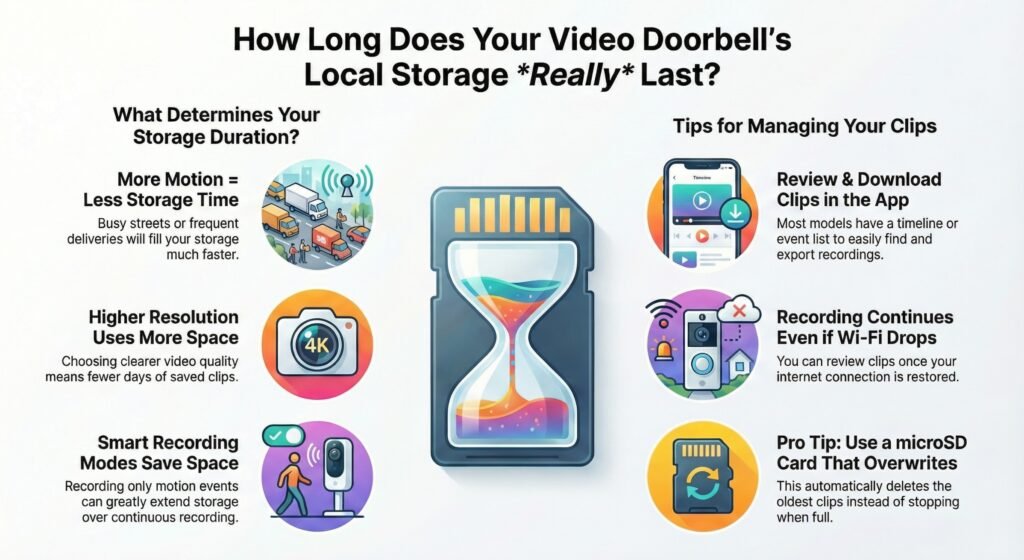
Local storage is the main reason people choose a video doorbell with local storage—but the real question is how long your clips actually stay available. The answer depends on three things: how busy your front door is, your video quality settings, and the storage size.
Here’s what to expect in real life:
- More motion = faster overwrite. A busy street or frequent deliveries can fill storage quickly.
- Higher resolution uses more space. Clearer video usually means fewer days of saved clips.
- Smarter recording modes help. Some doorbells only record motion events instead of continuous recording, which can extend storage time.
How to review clips (fast):
Most models let you open a timeline or event list in the app, tap a clip, and export or download it. With a doorbell camera without cloud storage, make sure you can still access recordings even if your internet drops—many local-storage doorbells keep recording and let you review once the connection returns.
Pro tip: If your model uses microSD, choose a reliable card and check whether it overwrites old clips automatically (ideal) or stops recording when full (more annoying).
Table 3: Storage Retention & Playback Table (Guidelines Table)
| Storage method | What happens when full | Typical retention drivers | How you review clips | Best for |
|---|---|---|---|---|
|
microSD Card inside the doorbell (or nearby camera module). |
usually overwrite Some models can be set to stop recording instead. Must-check: “overwrite” vs “stop when full” |
|
app timeline
event list Open events in-app, then export/download if supported. |
Most homes that want simple local recording and easy upgrades (swap card size). |
|
hub Doorbell saves to a local hub/base in your home. |
overwrite or managed storage Retention is often more predictable if the hub has larger capacity. |
|
app timeline
hub library Playback usually feels smoother because clips live on the hub. |
People who want longer local history or plan to add more security devices later. |
|
on-device Built-in internal memory (no card required). |
often overwrite Storage size can be limited, so older clips may disappear sooner. |
|
app timeline Review in the app; exporting clips varies by model. |
Minimal setup when you want local clips but don’t want to manage a memory card. |
Quick reality check: retention isn’t a fixed number of days. It changes with motion volume, video quality, and clip length. For a doorbell camera without cloud storage, confirm you can replay clips in the app without paying and confirm whether it overwrites automatically.
Alerts Without a Plan: What Still Works Without Cloud Features
With no cloud involved, alerts become your main line of defense. Basic motion alerts can be noisy, while smarter models try to focus on people or packages. Without a subscription, alert quality depends entirely on the doorbell’s onboard processing.
Usually, you’ll get:
- Motion-based alerts with adjustable sensitivity.
- Person detection on some models, but not all of them.
- Live view access that’s faster since it skips cloud servers.
Quick alerts matter more than fancy labels. If your doorbell notifies you right away—even if it just says “motion”—you can react fast. In hands-on tests across multiple reviewers, the difference is usually speed and accuracy: some doorbells still send fast alerts without a plan, while others rely on paid features for smarter filtering.
Privacy Focused Video Doorbell Camera: what local storage really changes
With a privacy focused video doorbell camera, local storage can reduce outside access to your footage—but you still need strong app security and clear sharing controls. Your videos stay on your own network, not a company’s server. That gives you more control, but also more to manage.
Here’s what to look at:
- Who can access footage: Local-only storage means fewer outsiders can see your videos.
- Account requirements: Some brands still want you to create an online account.
- Deletion control: You’re in charge of when clips get erased.
This setup is great if you care about owning your data more than convenience. You lose remote backups, but you keep direct control—something a lot of folks prefer for a front-door camera.
Table 4: Must-Check Before You Buy (Pass/Fail) Micro Table
| Must-check item | Why it matters | Quick pass test (what to look for in specs or app) |
|---|---|---|
| Overwrite behavior | If storage fills up and the device stops recording, you lose future clips until you intervene. |
pass “Loop recording” / “overwrite oldest clips” / “continuous overwrite” is stated. fail “Stops when full” or “manual deletion required.” |
| Playback without plan | A “no subscription” doorbell only makes sense if you can actually replay clips without paying. |
pass App shows “events” or “timeline” playback with local storage enabled, no checkout prompts. fail Playback or downloads locked behind a plan. |
| Local storage during outage | Internet drops happen. The key is whether it still records locally and resumes access cleanly afterward. |
pass “Continues recording to local storage when offline” or “records on-device/hub.” fail “Requires cloud connection to record or save clips.” |
| App login security options | Your doorbell app is a front-door control panel. Weak security increases account risk. |
pass Two-step verification / 2fa, device login alerts, session control, strong password rules. fail No 2fa and no session/device management options. |
| Wi-Fi strength requirements | Weak signal causes delayed alerts, choppy live view, and missed motion events—especially on battery models. |
pass Strong signal at the door (good coverage through exterior walls), stable 2.4 ghz support. fail Frequent disconnects or weak signal at the entry; no way to improve placement/coverage. |
If a model fails overwrite behavior or playback without plan, skip it and move on—those are the two dealbreakers for a true no-subscription setup.
Subscription Free Video Doorbell Comparison: local storage vs cloud plans
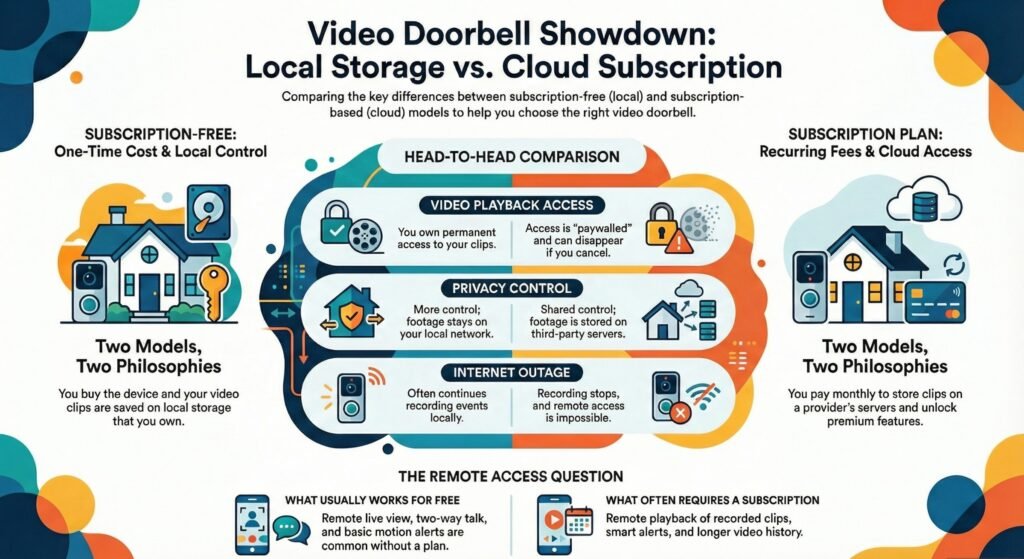
This subscription free video doorbell comparison comes down to storage, alert features, and what you keep without paying monthly. The main differences? Who owns your footage, how you pay over time, and which features you get without a subscription.
Table 5: Subscription-Free vs Subscription Table (Comparison Table: local storage vs cloud plan)
| Feature | No subscription (local storage) | Subscription plan (cloud) | Buyer impact (1-liner) |
|---|---|---|---|
| Clip history retention |
limited by storage Clips typically overwrite when storage fills (or stop, depending on settings). |
plan-based history Longer history is usually tied to the tier you pay for. |
Choose local if you accept overwrite; choose cloud if longer history matters. |
| Playback access |
owned access You can replay stored clips without paying, as long as the device/storage remains available. |
paywalled access Playback and downloads may be restricted if the plan ends. |
If you don’t want access to disappear, local storage is the safer default. |
| Smart alerts |
basic to moderate Motion alerts are common; advanced filters may be limited or less accurate. |
often enhanced More advanced detection and filtering features are commonly included with paid plans. |
Cloud plans often reduce false alerts, but you pay for that convenience. |
| Remote access |
usually live view Remote live view often works; recorded playback depends on how the system exposes local clips. |
typically full Remote viewing plus remote playback is usually consistent across devices. |
If you travel a lot, confirm remote playback behavior before buying local-only. |
| Privacy control |
more local control Footage stays on-device/on a hub/on your network, reducing third-party storage exposure. |
shared with provider Footage is stored on external servers; privacy depends on account controls and policies. |
Local storage can feel more private, but strong app security still matters. |
| Long-term cost |
one-time focus No recurring plan required for basic recording and playback (storage upgrades are optional). |
recurring fees Ongoing cost to keep cloud history and premium features active. |
Local is predictable; cloud can outgrow the original purchase price over time. |
| Internet outage behavior |
often keeps recording Many local-storage setups can still record events during outages and sync viewing later. |
more dependent Cloud recording may be limited during outages, and remote access won’t work without internet. |
If outages are common, local recording can be the more resilient option. |
Note: exact behavior varies by model and app. Before buying, confirm whether recorded clips remain viewable without paying and whether local storage overwrites automatically.
Ownership and Costs
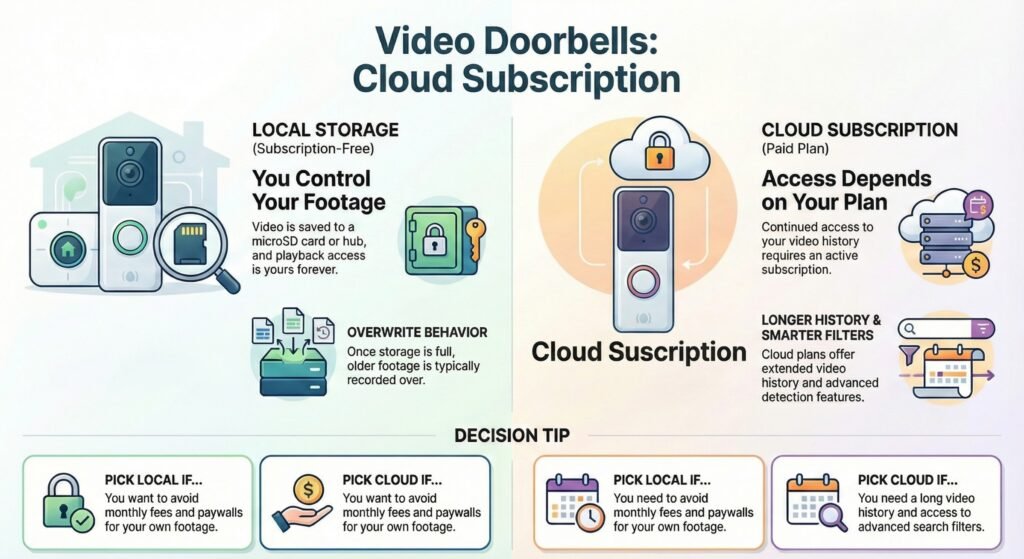
With a subscription-free video doorbell, you pay once and keep access to its core features. Clips are saved locally—on a microSD card, built-in memory, or a hub—so there are no monthly fees or contracts.
Subscription models can look cheaper upfront, but recurring plans often cost more over time just to unlock basic playback and history. If you plan to use your doorbell long-term, owning your footage and costs upfront is usually the simpler, more predictable option.
Cloud Storage Limitations
Cloud-based doorbells store video on external servers, which means access often depends on an active subscription. Cancel the plan, and older recordings may disappear.
A doorbell camera without cloud storage saves clips locally instead—on the device or a home hub—so playback doesn’t vanish when payments stop. The tradeoff is storage space: when it fills up, clips overwrite automatically. Instead of paying for more history, you control retention through storage size and settings.
Remote Viewing Without a Subscription: what works and what may not
A common worry is that “no subscription” means no remote access. In practice, many models still allow remote live view, motion alerts, and two-way talk without paying.
The real limitation is usually recorded playback and advanced filtering. Local storage fills up and overwrites clips, and smarter event labels or backups are often tied to paid plans.
What matters most is whether you can replay local clips and access live view reliably when you’re away. If remote checks are important for travel or deliveries, prioritize a doorbell with a stable app and clear playback behavior, and treat extra AI features as optional.
Table 6: Remote Access Reality Check Table
| Feature | Usually works without paying | Might be limited | What to check before buying |
|---|---|---|---|
| Live view | often yes Remote live view from your phone when the doorbell is online. | depends Can be slower or less reliable on weak Wi-Fi or with aggressive battery saving. | Does the app allow remote live view without a plan? Any “subscription required” notes for viewing outside your home network? |
| Motion alerts | yes Basic motion notifications are commonly included. | accuracy varies False alerts may be higher if advanced filtering is paywalled. | Can you adjust sensitivity, zones, and notification frequency without paying? |
| Two-way talk | usually yes Speak/listen to visitors through the app. | quality varies Delay or audio quality can drop on weak connections. | Is two-way talk listed as a core feature without a plan? Any limits on remote usage? |
| Recorded playback | sometimes Local clips can be viewable without paying if the app supports it. | common limitation Some models restrict playback, timeline access, or downloads without a plan. | Can you replay recorded clips in the app without subscribing? Is playback available remotely or only when on home Wi-Fi? |
| Smart event filters | basic Simple motion/person alerts may exist on-device. | often paywalled Package detection, rich event labels, and advanced filtering may require a plan. | Which “smart alerts” are included free vs paid? Are the labels you care about subscription-only? |
| Backup and export | varies Some allow saving/downloading clips from local storage. | sometimes limited Automatic cloud backup is usually a paid feature; exporting may be clunky on certain apps. | Can you export clips easily (download/share) without paying? Does the system offer any local backup option (hub/NVR) if needed? |
Tip: “No subscription” usually means basic alerts and live view stay available. The make-or-break detail is whether recorded playback and exports remain fully usable without paying.
Feature Access Differences
Paid plans often hide features behind a paywall—things like advanced alerts, package detection, long video history, or smarter event filters. Without a subscription, some models only let you use live view.
Most models in a subscription free video doorbell comparison still include the basics: live video, motion alerts, two-way audio, and local clip playback.
Some brands offer extra cloud upgrades, but they’re optional. Tech reviewers say many modern models deliver strong features with no fees, as mentioned in this subscription-free video doorbell comparison.
If you want reliable alerts and playback without getting locked into payments, subscription-free models keep the essentials unlocked from the start.
Top Picks: Video Doorbell No Monthly Fees (Local Storage Highlights)
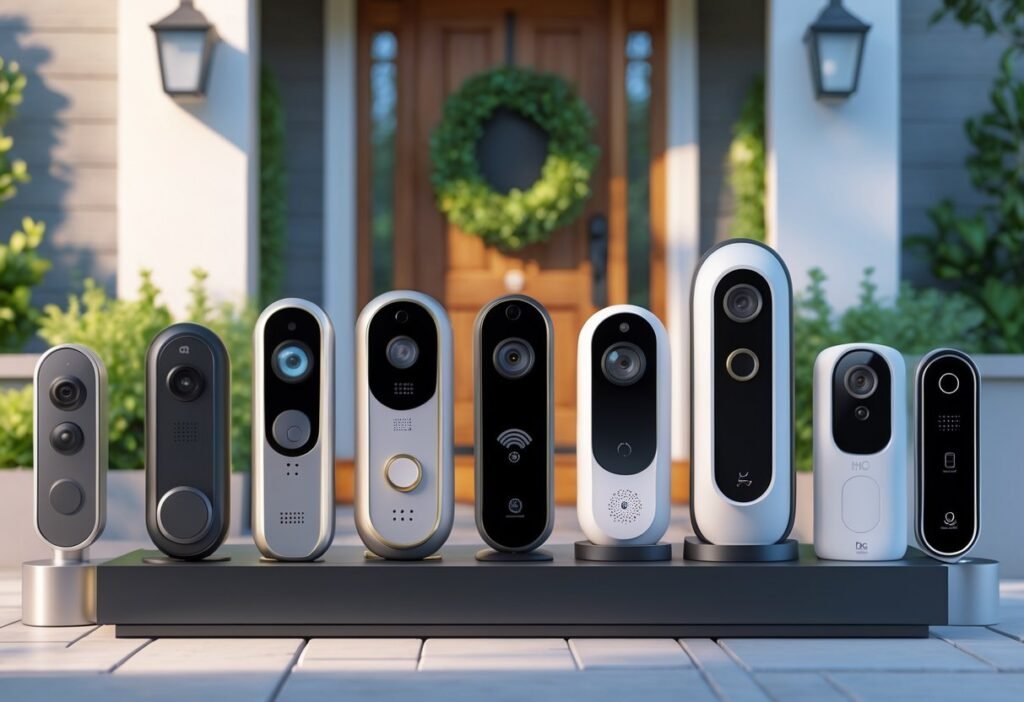
You can choose a video doorbell with no monthly fees and still get solid smart security—especially when it includes reliable local clip playback. The best picks use local storage, are easy to set up, and deliver clear night video without the cloud.
Table 7: Top Picks Summary Table
| Doorbell (model) | Best for | Storage type | Power | Remote viewing | Quick note (tradeoff) | Buy |
|---|---|---|---|---|---|---|
|
Best Overall eufy Security Video Doorbell E340 (Dual Cam) + HomeBase Local storage ecosystem (no monthly fee) |
Most homes / balanced features | Hub / base local storage (HomeBase) | Varies by bundle (wired or battery option) | Yes (live view + alerts; playback via local storage) | Usually best when paired with the base; confirm bundle includes the HomeBase. | Check price on Amazon |
|
Best Wired Value Reolink Video Doorbell WiFi Simple microSD local recording |
Fast response + consistent monitoring | microSD (on-device) | Wired | Yes | Needs existing wiring (or an electrician) for the cleanest setup. | Check price on Amazon |
|
Best Battery Pick Reolink Video Doorbell (Battery) Local storage + flexible mounting |
No wiring / renters | microSD (on-device) | Battery | Yes | Battery models can be more sensitive to Wi-Fi strength and power-saving settings. | Check price on Amazon |
|
Best Simple Bundle TP-Link Tapo D225 Video Doorbell (Hub Kit) Easy local playback + alerts |
Beginner-friendly local storage setup | Hub / base local storage (kit) | Varies by kit (often battery) | Yes (varies by setup) | Confirm the kit’s storage method and how playback works in the app before buying. | Check price on Amazon |
Most Reliable Local Storage Options
Local storage is a big deal because your video stays yours and you don’t have to pay extra. Many top-rated models save clips to a microSD card or built-in memory, so everything stays in your house.
Brands like Aqara, Eufy, Lorex, Reolink, and TP-Link get good marks in Consumer Reports for alert speed and video quality. They explain how these models skip the cloud but still deliver smart security features like motion alerts and two-way audio in their review of the best video doorbell cameras without a subscription.
Check how each doorbell handles storage before you buy. Some overwrite old clips on their own; others just stop recording when full. That affects how long you can go back and review footage.
Best Wireless Installation Choices
If you want quick setup and no wires, battery-powered doorbells are the way to go. You can mount them with basic tools and set them up over WiFi with your phone.
Subscription-free wireless models still cover the main smart home device features. You get motion alerts, live view, and two-way talk—no hidden fees. Battery-powered doorbells can still deliver the basics without fees, but performance depends heavily on Wi-Fi strength, motion settings, and how aggressively the device saves power.
Battery life is the main tradeoff. Frequent alerts and cold weather can drain batteries faster. Expect to recharge or swap them every few months, depending on how busy your front door is.
Strongest Night Vision Performance
Good night video depends on infrared range, where you put the camera, and how much light is around your entry. Doorbells without subscriptions can still get clear night footage if they’re built right.
Most top picks use infrared LEDs to catch faces and movement up close. With no cloud doing the heavy lifting, night video quality comes down to the doorbell’s sensors, infrared performance, and your porch lighting.
Don’t just look for the longest night range. Consistent exposure and sharp contrast matter more. A porch light helps more than extra megapixels. Good night vision makes it easier to spot visitors and makes alerts way more useful after dark.
Which Subscription-Free Doorbell Fits You (travelers, integrators, privacy)
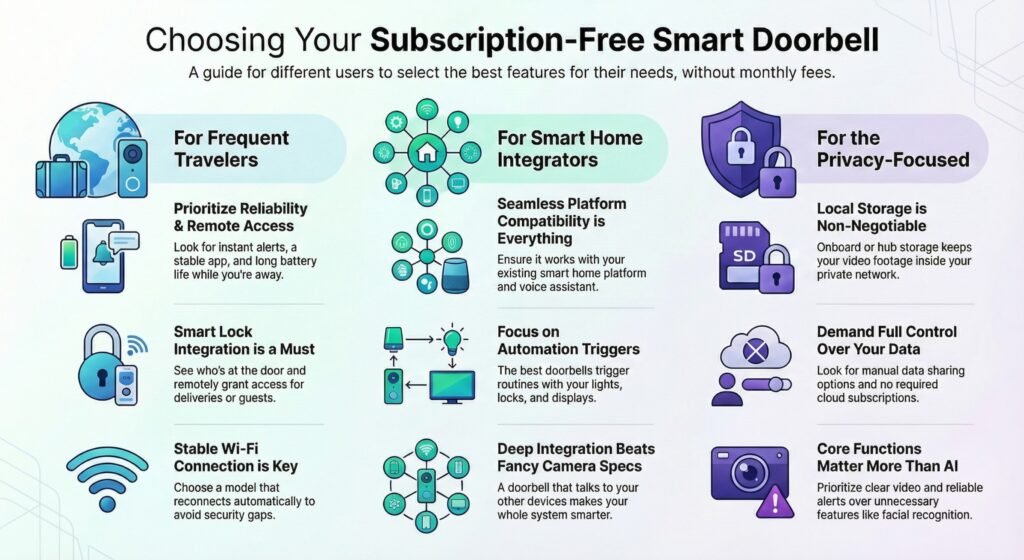
Every home is different, so the best doorbell depends on how often you’re away, how advanced your smart setup is, and how much control you want over your video data.
For Frequent Travelers
If you’re away often, quick alerts, clear video, and reliable remote access matter. Missed notifications defeat the purpose of a security doorbell.
Go for doorbells that send instant motion alerts—not those weird, delayed recaps. A smooth mobile app is more useful than a million camera modes. It’s way easier to scroll a simple timeline when you’re on the move.
Battery life is a big deal too. The longer between charges, the less you have to worry while you’re away. Some doorbells handle sketchy Wi‑Fi better and reconnect on their own, which is a lifesaver.
Travelers often mix in smart locks. That way, you see who’s at the door and let people in for deliveries or guests, even if you’re miles away. It makes smart security actually smart—no extra hassle.
Here’s a quick checklist for travel:
- Fast push alerts
- Stable app (seriously, don’t settle)
- Long battery life
- Remote access, no sneaky fees
For Smart Home Integrators
If you’ve already got a smart home platform going, compatibility is everything. The best doorbell just fits in—no weird workarounds or headaches.
You’ll get the most out of doorbells that trigger routines. Think: porch lights turn on, cameras record when the lock opens, or alerts pop up on your smart displays.
Deep integration beats fancy camera specs. A doorbell that talks to your smart locks, lights, and speakers makes life easier. Less app-juggling, fewer settings to mess with.
Some smart home brands play nicer with certain doorbells. Double-check it works with your voice assistant and automations before you buy. Saves a ton of frustration later.
Top things for integrators:
- Native platform support
- Automation triggers
- Shared controls with the rest of your smart security
For Data Privacy Focused Shoppers
If you care about privacy, you want to control your footage. No subscriptions, no getting locked into a company’s cloud. Local storage matters most—AI tricks, not so much.
Doorbells with onboard or hub storage keep your video inside your network. That limits who can see it and saves you money. Eufy’s a good example, focusing on local storage and privacy-first design (see their approach in this privacy-focused smart doorbells guide).
But you still need basics: clear video, reliable alerts, and easy exports. Fancy facial recognition? Not really necessary here.
Privacy-minded buyers should look for:
- Local video storage
- No required subscription
- Manual data sharing controls
This setup is for folks who want smart security but don’t feel like handing over their home footage to someone else.
Smart Home Compatibility Without Cloud Dependence
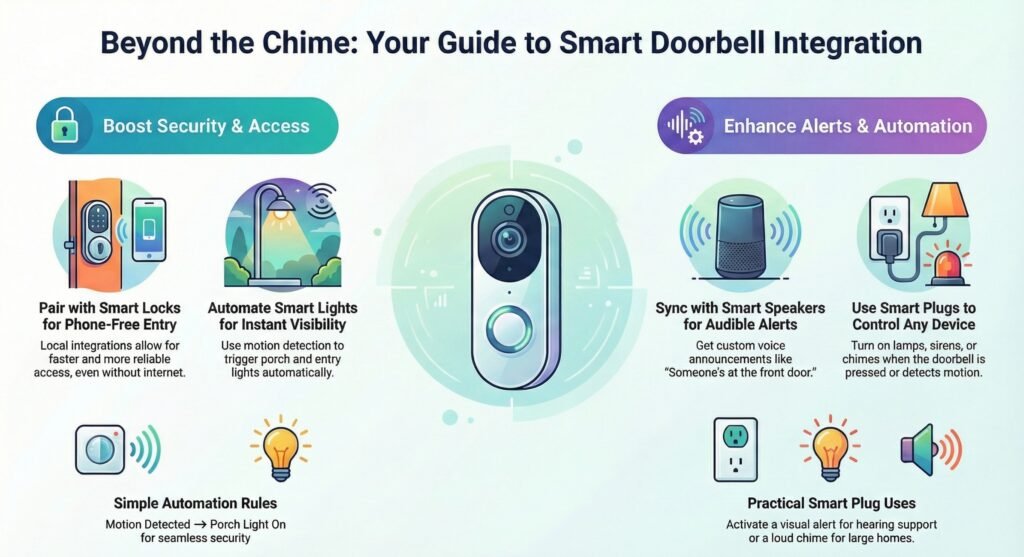
A smart doorbell without subscription plan should still integrate cleanly—so you can hear alerts on speakers, trigger lights, or pair with a lock without extra fees. Good integration saves time, cuts down on steps, and helps everything work together when it matters.
Syncing with Smart Locks
Pairing with a smart lock is key if you want to let people in without fiddling with your phone. Some doorbells can unlock the door when you say so, others just ping you with alerts.
Focus on local control and direct integration, not just cloud-based connections. Local actions are faster and keep things running even if you’re not paying monthly. That’s huge for smart security without extra costs.
Check if your doorbell supports common lock brands and open standards. Here’s a solid guide on smart home ecosystem compatibility factors if you want to dig deeper. Shared protocols mean fewer setup headaches.
One question before you buy: Can you unlock the door from the doorbell screen without jumping through hoops?
Pairing with Smart Speakers
Smart speakers make doorbell alerts way more noticeable. Instead of staring at your phone, you’ll hear right away when someone’s at the door.
Look for native voice assistant support—not just some clunky workaround. Direct pairing with Alexa or Google Assistant means faster, more reliable alerts.
Some doorbells only do basic chimes, but others let you set up custom voice announcements like, “Hey, someone’s at the front door.” In daily use, this is often more useful than higher camera resolution.
If you’ve already got speakers, check compatibility before you buy. Wide support—like what you’ll find in big smart home compatibility lists for Alexa and Google Home—means you won’t miss alerts.
Connecting to Smart Lighting
Smart lighting’s a simple way to boost safety and visibility. When your doorbell detects motion, lights flip on—no need to fumble for a switch.
Go for event-based triggers instead of manual routines. Motion-activated lights are a game changer for late-night visitors, deliveries, or just feeling safer.
Lots of setups use Zigbee, Z-Wave, or Wi‑Fi lights. Sticking to one protocol helps avoid delays or missed triggers. Battery lights? Low-power standards are best.
Keep the rules simple:
- Motion detected → porch light on
- Doorbell pressed → entry lights brighten
- No motion → lights off after a while
This keeps your smart lighting helpful, not annoying.
Interfacing with Smart Plugs
Smart plugs let your doorbell control regular stuff—like a lamp, chime, or siren plugged into any outlet.
Pick doorbells that support automation triggers, not just notifications. That way, a smart plug can react instantly to motion or a button press.
Common options like an Amazon smart plug work nicely when the doorbell supports Alexa routines. Local triggers are usually more reliable than cloud-based ones.
Smart plug ideas tend to be straightforward:
- Turn on a hallway lamp when the doorbell rings
- Power a loud chime for big houses
- Activate a visual alert for hearing support
These little automations add value without making things complicated.
Security Basics for a Doorbell Camera Without Cloud Storage
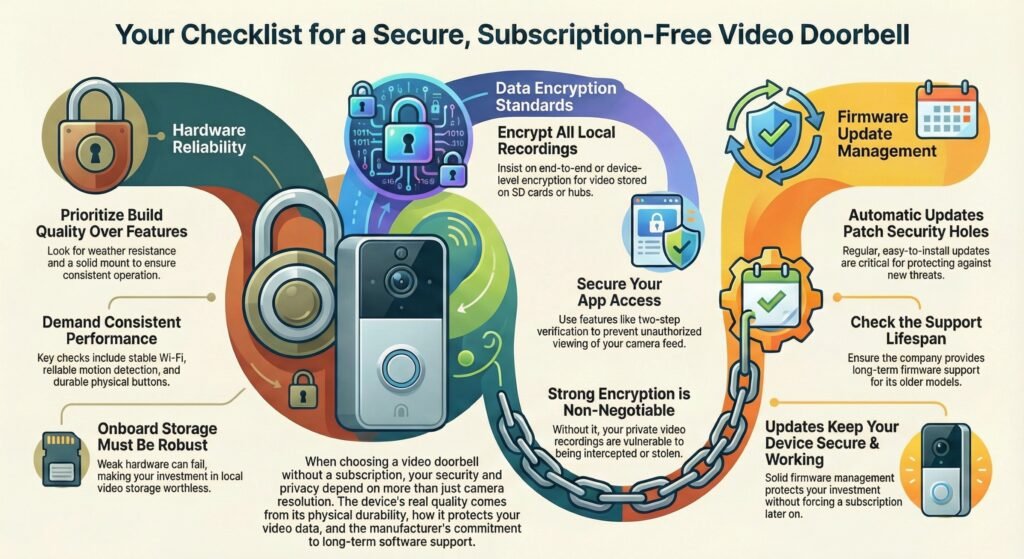
You count on your video doorbell to work every day, protect your entry, and keep your data private. The real quality comes down to how tough the hardware is, how it secures your video, and whether the company keeps the software up to date over time.
Hardware Reliability
Reliable hardware is the difference between a doorbell that keeps you safe and one that just annoys you. You want something that can handle heat, cold, rain, and sun without the camera dying or the battery draining too fast.
Look for good build quality and steady power rather than just a bunch of extra features. A solid mount cuts down on vibration from doors or wind, which helps with motion accuracy. Wide viewing angles are nice, but only if the picture stays clear at the edges.
Practical things to check:
- Consistent motion detection—no missed alerts
- Stable Wi‑Fi that stays connected through walls
- Physical buttons that still work after months
If you’re skipping a subscription, your doorbell needs to store or process video locally. Weak hardware can ruin that by dying before you get your money’s worth.
Data Encryption Standards
Your doorbell camera is recording sensitive stuff. Strong encryption keeps that data safe from people you don’t want seeing it.
Look for end‑to‑end encryption or device‑level encryption for stored video. This way, only you can watch your recordings—even if someone tries to intercept them. Don’t trust products that leave clips unencrypted on SD cards or hubs.
Things to pay attention to:
- Encrypted local storage, not just encrypted uploads
- Secure app login, like two-step verification
- Clear privacy controls so you can turn off sharing
These security basics matter way more than camera resolution. Without them, a subscription-free doorbell can still put your data at risk.
Firmware Update Management
Firmware updates are what keep your doorbell safe long after you install it. Without updates, new security holes stay open.
You want regular updates that install automatically or at least with a single tap. Manual updates often get ignored, which weakens your security. Good update notes tell you if the fix is for bugs, speed, or security.
Check for:
- How often updates come out, not just if they exist
- How long the company supports old models
- If updates break stuff you already use
Solid firmware management keeps your doorbell working and secure—without forcing you into a subscription later on.
Final Recommendation: best video doorbell without subscription for most homes
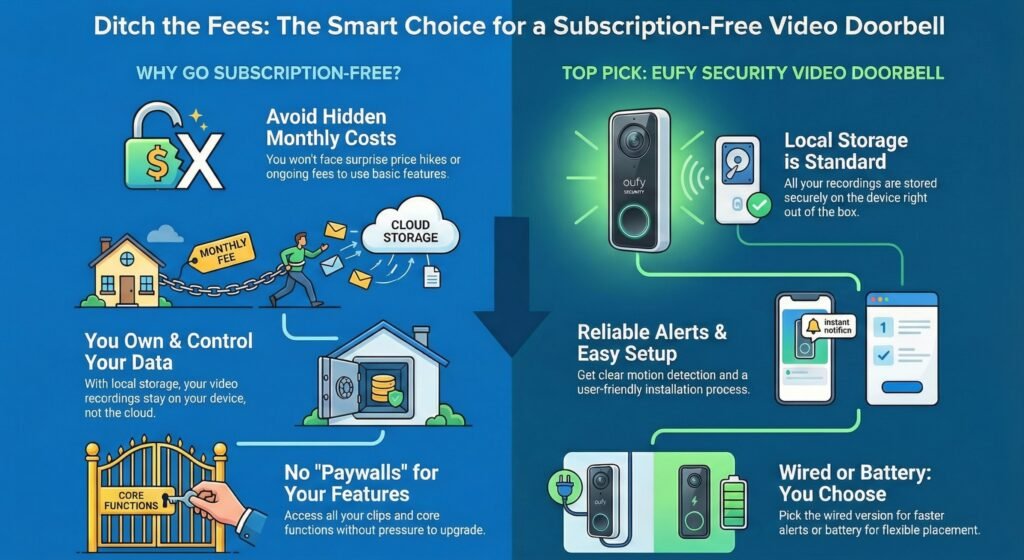
If your priority is owning your footage and avoiding monthly fees, a local-storage model like the Eufy Security Video Doorbell is the most straightforward choice. You keep access to clips, alerts, and playback without worrying about plans disappearing later.
It’s the right pick if you want reliable alerts, clear video, and predictable long-term costs—not extra features that only work as long as you keep paying. Local storage removes the “what happens if I cancel?” question entirely.
Choose wired if you want faster alerts and nonstop coverage. Choose battery if installation flexibility matters more than absolute uptime. Either way, the core experience stays unlocked.
If you want a doorbell that works the same way next year as it does on day one, skip subscription-dependent models and stick with local storage.
Video Doorbell Without Subscription: Common Buyer Questions
- What is the best video doorbell without subscription if I want to keep recordings?
Look for a video doorbell with local storage (microSD, hub, or on-device memory) so clips are saved without monthly payments. - Will a video doorbell no monthly fees still record motion events?
Yes—most models still record motion clips locally, but advanced event filtering may be limited compared to paid plans. - Is a doorbell camera without cloud storage safer for privacy?
Often, yes. A privacy focused video doorbell camera keeps footage on your network, but you should still use strong app security and control sharing settings. - Wired vs battery video doorbell no subscription: which is better?
Wired is usually better for nonstop coverage and faster response. Battery is easier to install but needs recharging and may use power-saving limits. - Can a smart doorbell without subscription plan still work with my smart home?
Many can. Just confirm it supports your speaker or display alerts and can trigger simple automations without requiring a paid plan.